
15 Years of Free Software Projects: A Review
Fifteen years ago, I wrote an article summing up my first year as a free software developer. I then wrote regular reviews over the nine years that followed. I covered all sorts of topics: the first steps, contributing, failures, and so on...
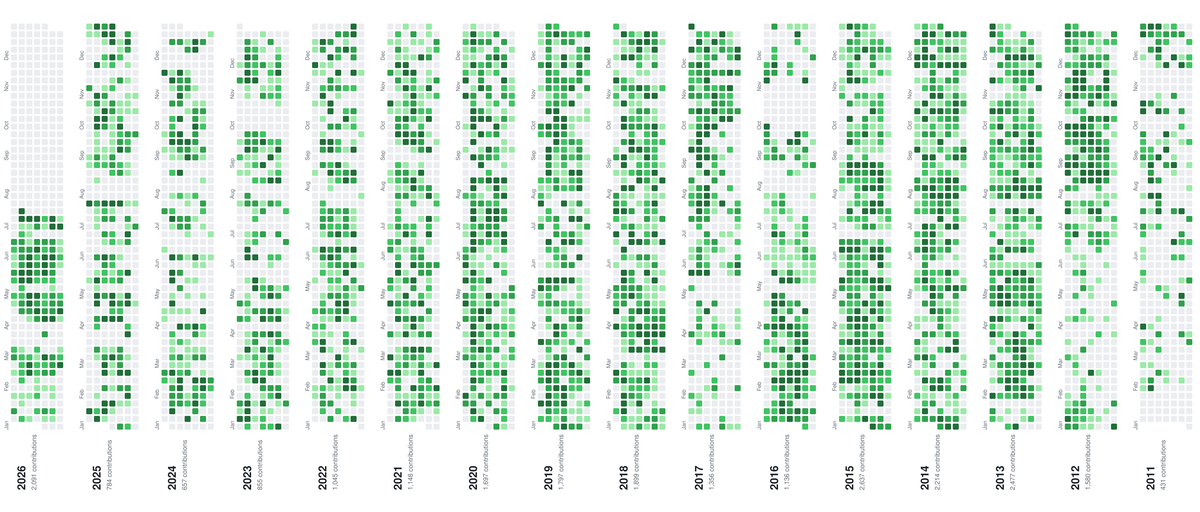
Fifteen years ago, I wrote an article summing up my first year as a free software developer. I then wrote regular reviews over the nine years that followed. I covered all sorts of topics: the first steps, contributing, failures, and so on. I finally wrapped up those ten years reflecting on the satisfaction I had drawn from all these accomplishments. I thought I had covered everything, but after five more years, I felt I still had things to share.
Over this period, my contributions have been made exclusively to my project Kitsu (AGPL license), backed by my company CGWire. Kitsu is a project management software for animation and VFX studios, built on JavaScript (Vue.js), Python (Flask), and Postgres. It's an important building block of their information systems. Around this software, we provide hosting and support services, which have allowed me to make a full-time living from it for nearly 10 years now.
For this review, after a recap of where Kitsu stands, I'll cover several themes: collaborating with a hugely successful project, being a parent and a developer, organizing our first event dedicated to our solution, finding a viable business model, doing free software in the age of generative AI, and finally I'll step outside the Kitsu scope with some thoughts on personal data and LLMs.
Previous reviews: 1, 2, 3, 4, 5, 6, 8, 9
The state of the project
Today, Kitsu is recognized as a solid solution across the entire animation sector. We equip around 500 studios with 1 to 1,000 people (most between 20 and 50 people) in more than 30 countries worldwide.
The films and series using Kitsu are mainly independent productions. Many of them have received prestigious awards, with recurring successes at the Annecy Festival (the reference in 2D animation), but also at Cannes, the Césars, and the Oscars. The most awarded of them is Flow (a 3D film, as it happens!).
It's a rather gratifying result. That said, we've never broken out of that indie sphere; the big studios have always snubbed our solution, preferring the American standard run by Autodesk. As a result, our financial performance has remained very modest compared to typical startups (€500k/year in revenue). This should be put in perspective, though: the sector has been going through a severe crisis since 2023, and surviving it is already an achievement in itself.
On the team side, there are 5 of us working on it full-time, and we benefit from regular contributions from our community (tickets, PRs, plugins, and recently a mobile app). So there's sustained activity around the product.
As for the license, Kitsu is still under AGPL. Its installation and use are fully documented, but it still depends heavily on the commercial structure behind it (CGWire). Several community members have a good understanding of how it works, but not enough to maintain it themselves.
In short, the project is moving forward slowly but surely and doing well. The tool fulfills its role, and the community is happy and growing. We've been able to keep the license active all along, and adoption continues to increase.
The encounter with Blender
Through my previous project, the late Cozy Cloud, and more recently the OSS Founders events, I had already had the chance to meet the founders of popular free software projects. Among them were the CEOs of Matomo, Nextcloud, and Strapi. These exchanges are always exhilarating, interesting, and informative, but they never go further than a few good conversations and handshakes.
With Kitsu, for the first time, I had the opportunity to collaborate directly with a successful free software project, and no small one at that: Blender (a booming 3D creation tool). Not only did I get a front-row seat to their recent rise, but I also took part in it a little.
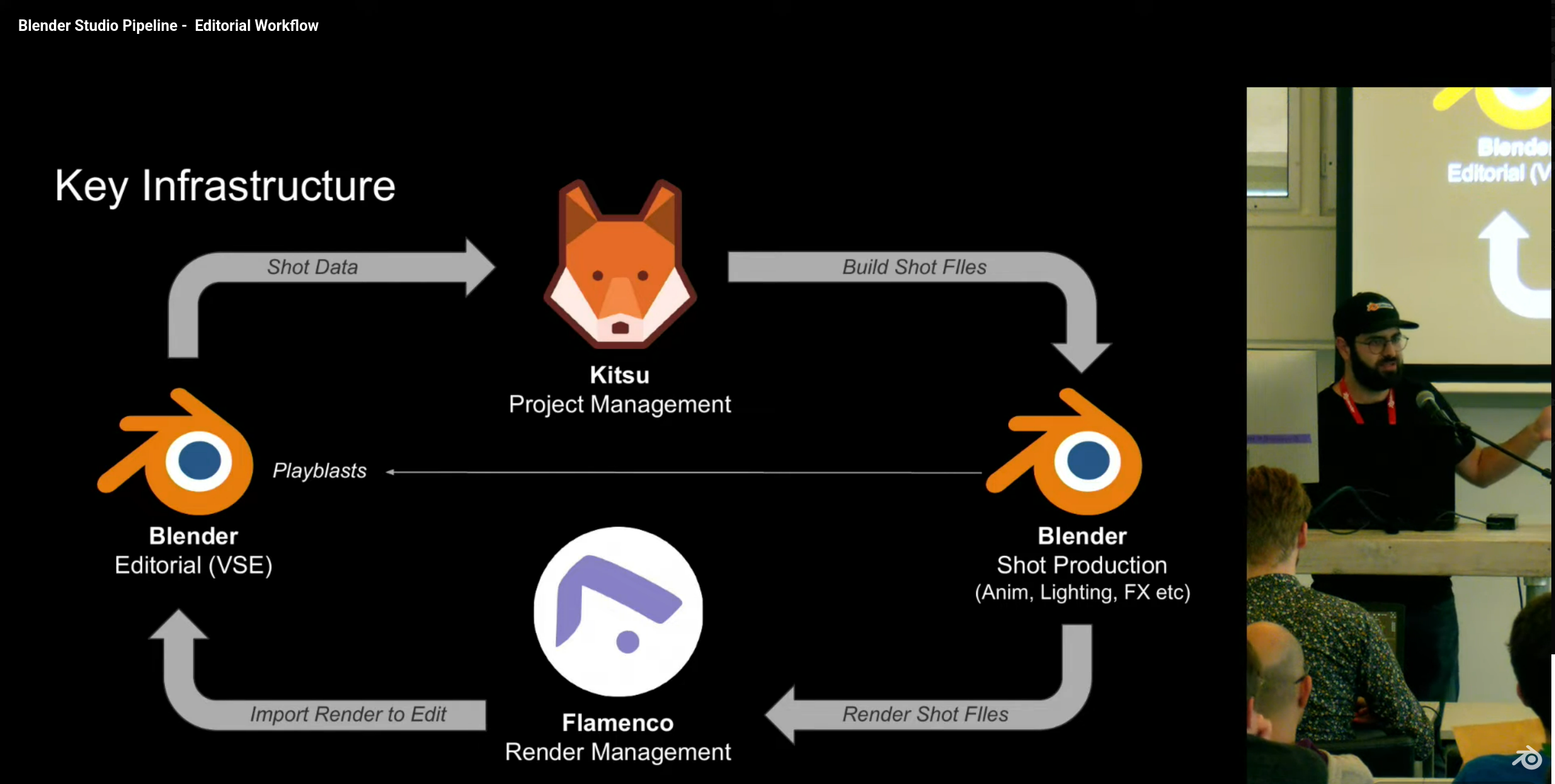
Indeed, most studios using Blender turned naturally to our solution to manage their projects. The foundation was maintaining a similar management tool (Attract), but its lead developer was none other than Francesco Siddi (now CEO). His growing involvement across every area of the foundation left him little time to work on it. Seeing Kitsu's progress, he simply figured it was easier to support us than to keep maintaining his own project.
And so Kitsu was chosen to track the Blender Studio's video projects, and was also championed by them. We thus gained recognition and benefited from international visibility. The studio didn't stop there: it also supported us financially a little by commissioning a few features in the software. In return, our software proved quite useful to them for getting organized and easing the creation of their films. Let me take this opportunity to thank them once again for their help!
Another important element, which had a big impact on us, was the presentation of the Blender project that Ton Roosendaal gave me during my visit to the studio (he was still CEO at the time, but less involved as he had started treatment for the cancer he would later be cured of). He shared with me the foundation's deep values. Their core mission is to give any artist the freedom to create by providing them with high-end digital creation tools. Blender is in fact much more than a piece of software; it's a genuine movement for a more open world.
This led me to push Kitsu's mission in the same direction: the idea was no longer just to allow animation teams to collaborate smoothly. We also wanted to enable any studio in the world to have the organizational tools and the method to carry a feature film or a series through to completion, despite ever-tighter budgets.
Indeed, animated film narratives are still not diverse enough and often draw on Disney's. Every independent film that emerges offers a different vision of the world. This diversity frees us from the conceptions conveyed by big-budget films. Since the meager budgets of indie films aren't always enough to finish the project at the desired quality, good organizational tools are needed to optimize the effort. These used to be hard to access (expensive and complex to implement); Kitsu, being free software and simple to use, made these tools accessible.
Thus, many original works like Flow, Jim Queen, In Waves, Chicken for Linda!, and Allah Is Not Obliged were able to see their artistic vision through to the end. And the phenomenon has repeated itself all over the world, as recently with films like Bravecat in Latin America or Igi (in progress) in Georgia. These new works matter because they free our imaginations by offering us another way of looking at the world.
You get the point: meeting and being welcomed by the Blender team and community was transformative for our project. On the one hand, we were able to extend our visibility, but above all, we could aim for an even more meaningful purpose.
Free software and parenthood
On a completely different note, about 3 years ago, I became a father. This happy event had a significant impact on my projects and contributions.
It will surprise no one, but being a parent takes a lot of time and energy. All the more so as it happened against the backdrop of the animation sector crisis, which meant I couldn't really ease off on Kitsu.
So I inevitably had to sacrifice quite a few activities. From that point on, any contribution became too hard for me to find motivation for. I also had to stop organizing the meetups I mentioned in my previous post. Even keeping up with the news from the various free software associations wasn't always easy.
My schedule was turned upside down, and the evenings drained me of enough energy to leave me unmotivated to look at other code repositories or start new projects. It made me realize just how hard it is for a parent to contribute. I'm all the more admiring now whenever I meet a developer who's also a parent.
To temper this: it gets better over time. As proof, I managed to write this article! And this situation can also be seen as an opportunity to set yourself strict limits and focus on a given problem rather than flitting from one project to another.
The pressure of the free offering
Trying to sell "free" software is no easy thing. In reality, we sell hosting and support around Kitsu. So yes, free access makes dissemination easier, but it also leads us into a few pitfalls.
A first issue is that self-hosted installations are rarely clean, and the software isn't always used optimally. So we sometimes come across unhappy users without understanding the source of the problem. But when you dig a little, it turns out they're using a self-hosted version and don't have the latest release, or simply aren't aware that a feature exists.
Studios think they're saving money by doing without us, but forgoing a vendor for a key piece of software also has a cost (installation, maintenance, the impact of incidents, sub-optimal use). And it affects us negatively, too, in the sense that we can generate dissatisfaction without being able to do anything about it.
This problem is nonetheless offset by another phenomenon: many people are happy to have access to this kind of tool when their budget wouldn't otherwise allow it. We've lost count of the studios that come and thank us at our booth without our ever having heard of them.
Even so, this creates a situation where our biggest competitor is ourselves. We're forced to argue our own case to users who are already convinced. It has also happened that customers using our cloud, at renewal time, announce the price they intend to pay while threatening to switch to self-hosting if we refuse.
And with the sector's crisis, many studios have decided to switch to the self-hosted version. Recently, we launched a lightweight, low-cost support offer. Its success was very lukewarm. This put us in the uncomfortable position of having to beg for money from companies that derive substantial benefits from our solution.
This creates a situation that's hard to manage. We hadn't anticipated it; we thought that productions with significant budgets wouldn't dare do without the guarantee of proper operation offered by the vendor.
This shortfall clearly slows our progress and, above all, keeps us permanently on the edge. When the outlook isn't good, it puts us under particular pressure. Despite the virtuous dynamic of free software, it can also produce unpleasant situations for maintainers.
To compensate, we're also trying to build proprietary features external to the software: a synchronization system between different studios, an MCP server, video processing optimizations, multi-region setups, and so on. We have quite a bit of hope that this will motivate studios with a budget to switch back to a full offering.
To sum up, the fact that Kitsu is free software enormously stimulates the animation ecosystem. That said, it generates significant pressure on the company supporting its development. Keeping the project afloat while remaining free requires a lot of work.
Standardization
But the fact that the application spreads easily also provides a considerable advantage: little by little, the tool is becoming the industry standard. All the more so as our data model and our interfaces are fairly lightweight compared to competing offerings. Kitsu is therefore the easy tool to adopt, the one you can get started with very quickly as you move from studio to studio.
Even better, each studio can easily script connections with its own tools and with another studio's Kitsu. Since it's common to work in co-production (several studios financing and producing the project together), Kitsu's standard nature makes collaboration much easier.
On the school side, Kitsu is popular too. For students, the ease of use helps them set up their first projects. It also gives them a studio-like framework. That way, they'll know what's expected of them in terms of reporting and communication once they join a team. Future imaging professionals already know Kitsu and will be motivated to talk about it.
Given that the hard part of a film lies in the artistic work, providing a turnkey, easily accessible building block removes a real thorn from the side of all the industry's stakeholders. When Kitsu becomes the default choice, the problem of the organizational tool is solved. Production teams can focus on their respective crafts and, as a result, deliver more beautiful films.
The first Kitsu Summit
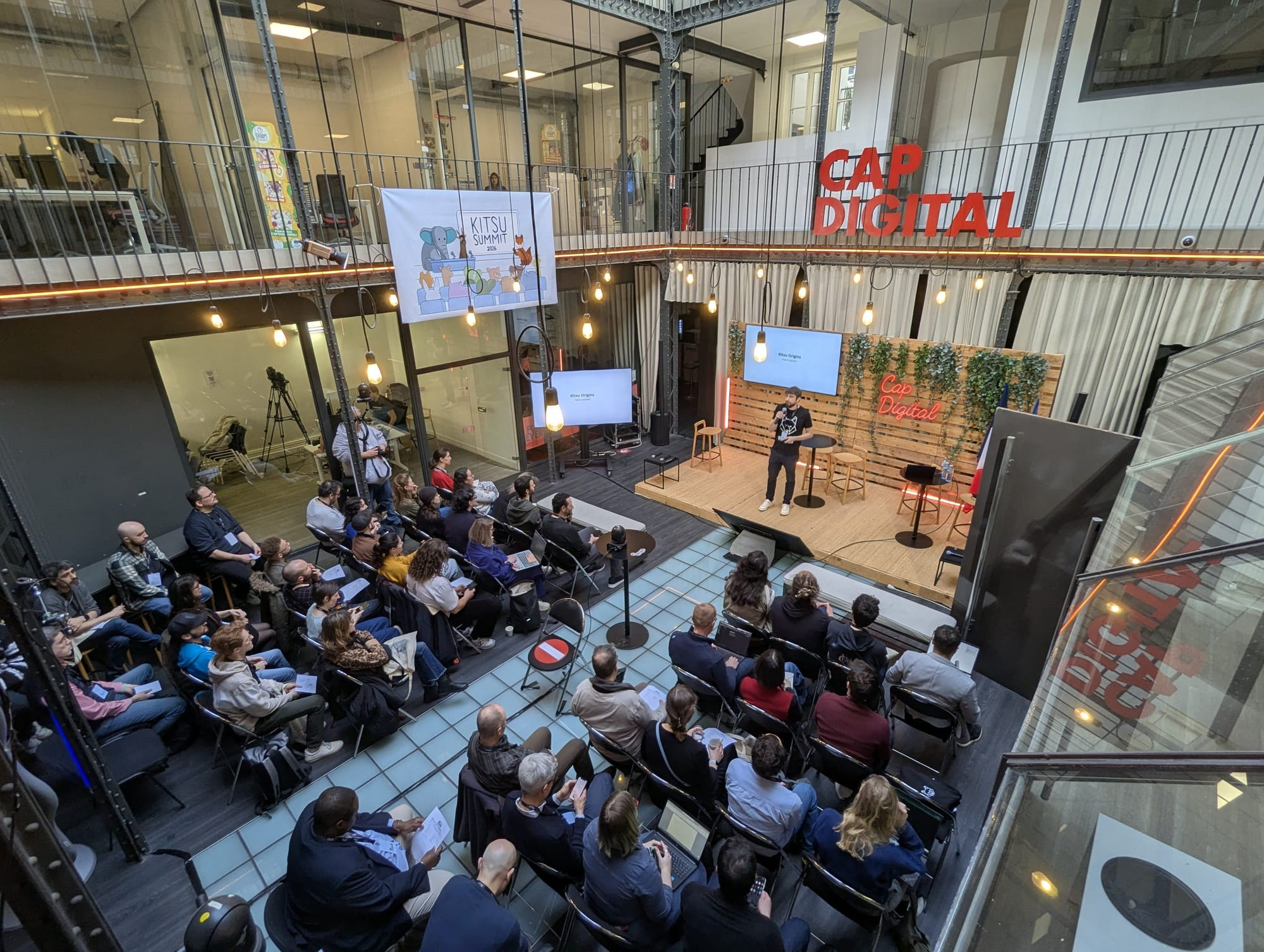
Building on this success, we organized the first one-day event dedicated entirely to our project. 70 people gathered around 12 talks about using Kitsu. We also welcomed a few sponsors.
This allowed us to bring together a whole range of players from our ecosystem. The community mingled in a joyful, good-natured atmosphere. We also talked with plenty of people we never get to see directly. This kind of event is obviously very energizing.
We also collected a lot of video footage, giving us substantial material to publish. It reinforced our credibility.
That said, organizing such an event required a lot of energy and was fairly costly (we ran it well at a loss). So we're not yet in a position to hold one every year, but the motivation for another one is there!
Code in the age of generative AI
As if the sector's crisis weren't enough, our profession as developers has recently been revolutionized. Generative AIs produce correct code quickly. So when I put on my developer hat, I now spend more time talking with an agent than working on the code directly.
Even though we're a small team, these new possibilities have kept us quite busy. We were able to launch long-awaited refactorings, plan others, and run repeated audits on our existing codebase (with each new advance in the models). We were also able to take on far more tickets. Internally, we also built many small utilities to make our lives easier, especially for our hosting infrastructure.
The quality assurance side of the project got the biggest boost, but we were also able to ship many features quickly and find solutions to problems that had been open for a long time (for example: applying an eraser to vector drawings).
Contributions haven't lagged behind. They're already more numerous, more substantial, and of better quality. A few examples: OpenID support, an MCP server, a mobile app for reviewing videos stored on the platform, an application plugin, and so on. To absorb them, we call on the models themselves to make reviews easier.
Nonetheless, more code means more work. It also requires us to rethink our organization to handle this new volume. Especially if contributions and tickets keep accelerating, we'll have to completely overhaul our continuous integration infrastructure (automating the analysis and processing of tickets, pull requests, Sentry reports, and so on).
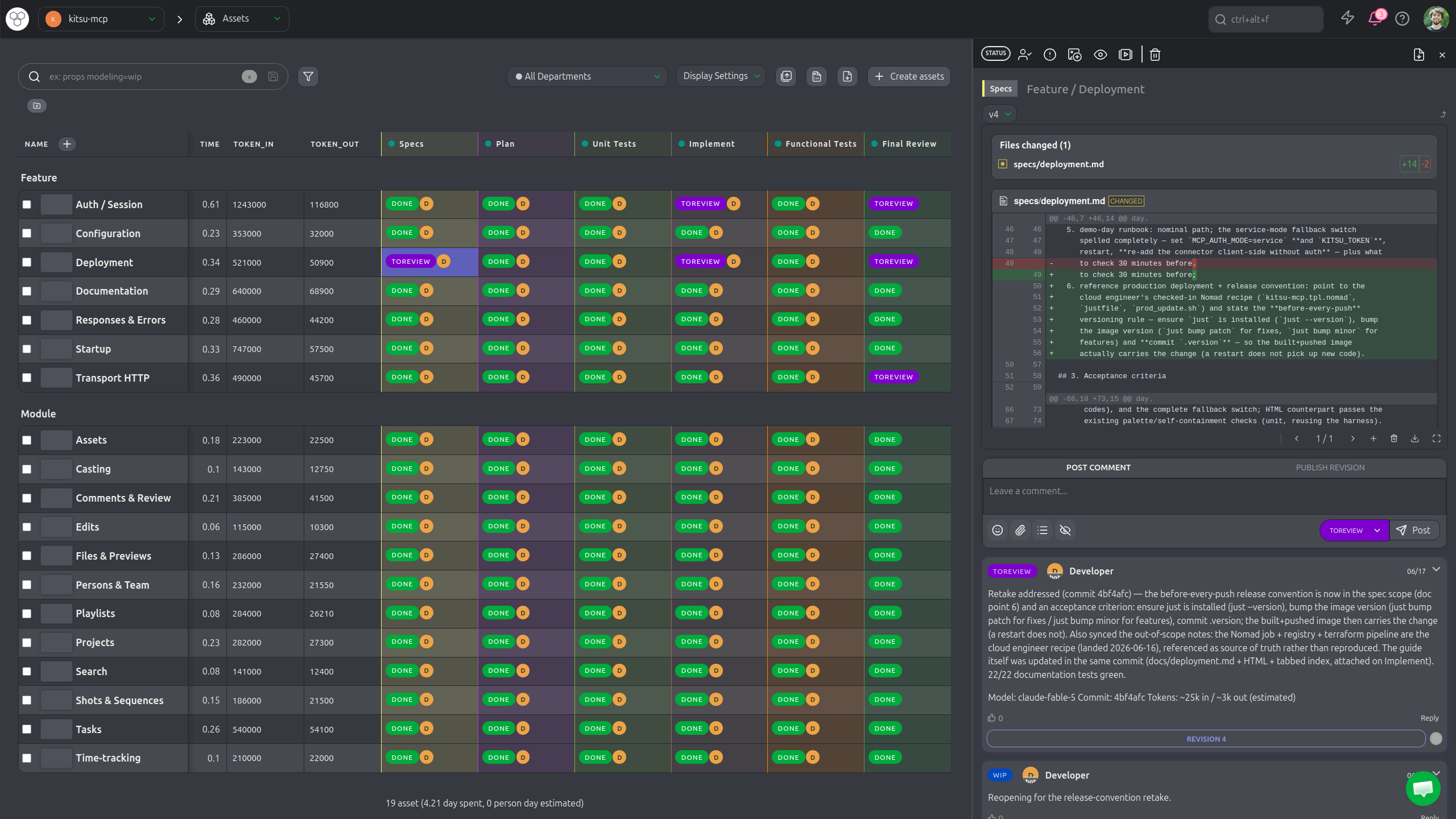
We were also able, for the first time, to use Kitsu to manage a full development project. Indeed, running an agent on a long project doesn't give clear feedback on progress. With our tool, we could track the entire progression, make adjustments via our discussion system, and, above all, monitor total token consumption (as well as total time spent). It's an unintended use of Kitsu, but it's interesting that in the age of AI, development work is tracked more like a classic industrial project: linearly, with consumption monitoring.
But all this comes with heavy downsides. The way models are built and distributed is harmful: massive resource extraction, the enslavement of click workers, excessive energy consumption, concentration of control over the models, and threatening messaging from the sector's players. And to come back to a more down-to-earth concern, the price of the token isn't settled yet. What's possible today won't necessarily be possible tomorrow.
To mitigate these aspects, we've written a manifesto to put a few guardrails in place: https://www.cg-wire.com/sustainable-ai-manifesto. These lines allow us to keep a minimum of respect for our users, but they don't solve all the problems mentioned above.
Among the other downsides, I'd also like to underline that the loss of control brought about by relying on third-party software is not negligible. We go from a stage where you can code everything at home, offline and privately, to a situation where you send everything to an external cloud, billed by usage and analyzing our data (Andrew Kelley talks about this better than I do).
Reviews are trickier, too. Before, doing a review helped the contributor grow. Now the review mainly serves to validate the code, so its impact is less. You also have to review a lot more generated code with exhaustive rigor. Sure, the models follow best practices, but the cognitive load of reviewing is greater nonetheless.
Another problem: coding agents push toward consumption and always suggest going further. Since the agent never tires, setting limits becomes difficult. Minimalism and agentic coding don't mix well.
Finally, the pleasure of coding isn't the same anymore. Spending a good day solving problems, cleaning up your code, and writing the associated documentation is far more enjoyable than discussing features, architecture, and objectives with an LLM.
So much for a first overview. The topic of generative AI in code is very complex. I have no recommendation to make; the idea here is to share some initial feedback from experience. This change is still very recent, and it's hard to have perspective on it. In passing, I recommend the excellent publication Limites Numériques, which raises quite a few good questions about LLMs and generative AI, notably on the user experience side.
AI and personal data
This brings me to a subject particularly close to my heart: the question of personal data (see the Cozy Cloud era). Indeed, through our interactions with LLMs, we produce and hand over personal data more than ever. The need to regain control over it is felt all the more strongly.
Especially since a new field of use seems within reach. With more context data, responses become more relevant and can draw on intelligent connections. Making available a virtual assistant primed to serve us becomes conceivable.
Today, free tools like Hermes or OpenClaw already make it possible to set up such an agent to organize our personal needs. But to fully benefit from it, you need access to a local LLM (very expensive today) and to structured, private personal data. You can, of course, work with off-the-shelf LLMs and the Google suite, but that amounts to handing yourself over entirely to a third party. And as we observed with Cozy Cloud, data is too fragmented across competing platforms. So it's harder to do this than with services you control and deploy on your own hardware.
I've also observed that the principle of self-hosting has grown in popularity: the Mac Studio is out of stock, the Framework Desktop is a resounding success, Google offers personal VMs (Gemini Spark), NVIDIA offers its box, and so on. That said, self-hosting is increasingly becoming a rich person's sport. Hardware prices are exploding, and to run a good LLM, you're looking at several thousand euros.
All this to say that personal computing will probably take on a new dimension, but it will likely benefit mostly the very well-off. I'll follow it closely all the same, and will encourage any free, privacy-protecting initiative in this domain.
Conclusion
These last five years have been very rich in events, lessons, encounters, and discoveries.
Even though I coded less, I learned a great deal about the dynamics of free software and the business models around it, all while keeping up with the latest technological developments. But above all, I got to watch my project grow and make its users happy. And finally, I got to work on one of the most exciting projects in the free software world.
My conclusion is that building a useful, free project has a net positive impact on the sector it targets. It leads to encounters you could never have hoped for before. But the more the tool progresses, the more substantial the means required to sustain it. Finding those means takes a lot of energy and leads to thankless situations. It's in those moments that the mission takes on its full meaning. You have to know why you get up in the morning to keep your motivation and find the energy to carry on.
Kitsu has also enabled a free software building block to break into a sector where proprietary solutions were nearly ubiquitous (aside from Blender's recent adoption). It's one more step toward a more virtuous digital world.
None of this has been a walk in the park, but I have to say it's quite an adventure, and one I don't tire of. Still, I look forward to reaching some form of stability; the market's ups and downs create an uncertainty that isn't always comfortable. I hope I'll be able to tell you I've gotten there in my next review, along with plenty of other lessons and news!
Note: This article was translated by an LLM from the original French article.